Building Physics and Standards
Energy Standards Compared
What Passivhaus, nearly zero-energy buildings and LEED each require, how they differ and what the choice means for a real project.
Why standards exist
Without common measures it would be hard to judge whether a building is frugal. A standard sets how much heating energy or primary energy a house may use per square metre per year, and describes how those values are proven. A design then becomes checkable and comparable with others. Standards are also the basis for grant programmes that tie support to reaching a certain level. Knowing the requirements lets a project be aimed at them deliberately.
The Passivhaus standard
The Passivhaus standard was developed in the 1990s and requires a very low heating demand. It is reached through a well insulated, airtight envelope, ventilation with heat recovery and an orientation that captures solar gains. A passive house manages without a conventional heating system or needs only a small backup. The standard is demanding but achievable with today's technology. It is not a state standard but a voluntary certification, widely used internationally.
The KfW Efficiency House
In Germany the KfW bank supports energy retrofits and new builds through the Efficiency House. There are several levels, depending on how close the building comes to a reference value. The lower the level, the stricter the demands and the higher the support. Proof is by energy demand and the quality of the envelope. For retrofits the Efficiency House is the main lever, because it sets the order of the work. Know the requirements early and the measures can be bundled to meet them.
Nearly zero-energy buildings
The European Union requires new buildings to meet the standard of a nearly zero-energy building, known as NZEB. This means a building with very low demand that covers much of it from renewable sources. The standard is not uniform but implemented by each member state. It is less strict than Passivhaus but binding for new build. Anyone building in the EU has NZEB as the legal lower bound to respect.
Other certificates
Alongside these standards are certificates such as LEED and BREEAM, which began in the English-speaking world and judge not only energy but also materials, water and site. They are common for offices and large projects. For a single house they are rarely relevant, because the effort is high and the benefit small. For larger developments they can be a marketing factor. Anyone using them should know that energy is only one part of what they assess.
Energy performance certificates
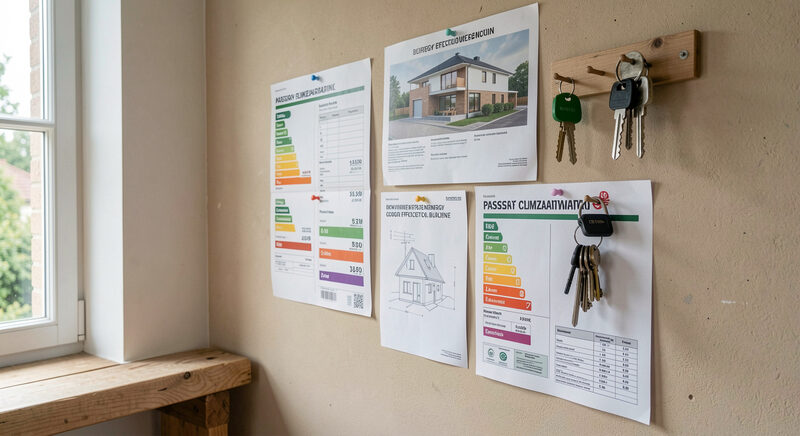
Every building that is sold or let needs an energy performance certificate. It shows the demand or the consumption and places the building on a scale. The certificate is not a building rule but an information tool for buyers and tenants. For owners it is useful because it documents the building's figures and makes them comparable. After a retrofit the certificate should be updated, so the improvement is visible. The values in it follow the same figures the standards use.
Primary and final energy
Standards measure demand in two ways. Final energy is what arrives at the building, such as gas or electricity. Primary energy also counts the upstream chain, extraction, conversion and transport. A building heated with coal-fired electricity has a high primary demand even if its final energy is low. That is why the standards favour renewable sources. Confuse the two and the requirements are misread, and the proof comes as a surprise.
What the demands mean in practice
All standards ask the same questions: how good is the envelope, how airtight is the building, how is it ventilated and where does the heat come from? A strict standard demands a better envelope, controlled ventilation and a smaller heating system. That affects cost and the order of work. Plan the requirements early and they can be met more cheaply than by retrofitting them at the end. The basics of sizing are in the article on heat load calculation.
Which standard to choose
The choice depends on the aim. For the lowest demand and the willingness to spend, choose Passivhaus. For grant funding, aim at the Efficiency House. For new build in the EU, NZEB must be met anyway. For retrofits a level of the Efficiency House is usually the pragmatic route, because it combines funding with an achievable target. The framework is set out in the section on retrofit and insulation.
Standards in a single view
Passivhaus asks for a very low heating demand and a good envelope. The KfW Efficiency House ties grant funding to a level of efficiency, with stricter levels giving more support. NZEB is the EU requirement for new build, less strict but binding. LEED and BREEAM judge energy alongside materials, water and site. Energy performance certificates document the result for buyers and tenants. All of them rest on the same figures, so understanding one helps with the others.
Choosing without overspending
The strictest standard is not always the best value. What matters is matching the target to the building, the budget and the funding available. A modest improvement across the whole envelope often beats a single very strict measure on one wall. Plan the target early, because it fixes the elements and the ventilation. Then check the grant rules and aim the work at the level that pays. The design principles behind these choices are in the section on building physics and standards.