Passive Systems
Passive Systems
How solar heat and ground energy heat, cool and ventilate a building: the thermal barrier, ground storage and earth-tube ventilation.
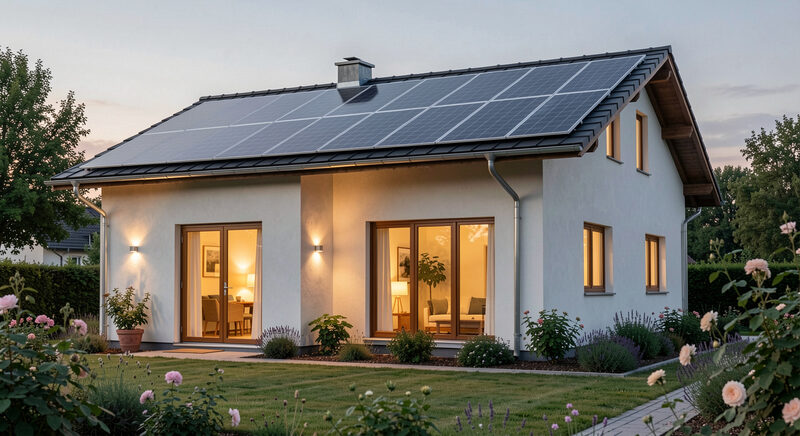
What passive climatisation means
Passive does not mean that a building does nothing. It means the main work is done by the building fabric rather than by a machine that is fed energy continuously. A heavy external wall, a store in the ground and a roof that absorbs heat together form a system that evens out temperature swings. The sun supplies the heat, the ground holds it, and the walls release it slowly into the rooms. In summer the direction reverses: the cool ground takes heat out of the incoming air before it reaches the rooms. The idea is old. Pre-industrial houses used thick walls and ground floors to damp heat and cold. Modern engineering has turned that instinct into components that can be calculated, with pipes, insulation and controls, but the principle has not changed.
The three building blocks
Passive climatisation usually rests on three blocks that support one another. The first is the envelope, the walls, roof and windows that limit heat loss. The second is the ground store, a volume below or beside the house that takes up heat over months and gives it back. The third is ventilation, which brings in fresh air and tempers it on its way through the ground. No block works alone. A very well insulated envelope without a store stays hot in summer, because the absorbed heat has nowhere to go. A large store without a good envelope loses its heat to the surroundings before it is used. Only together do they produce a building that runs without a boiler and without an air conditioner.
The thermal barrier in the wall
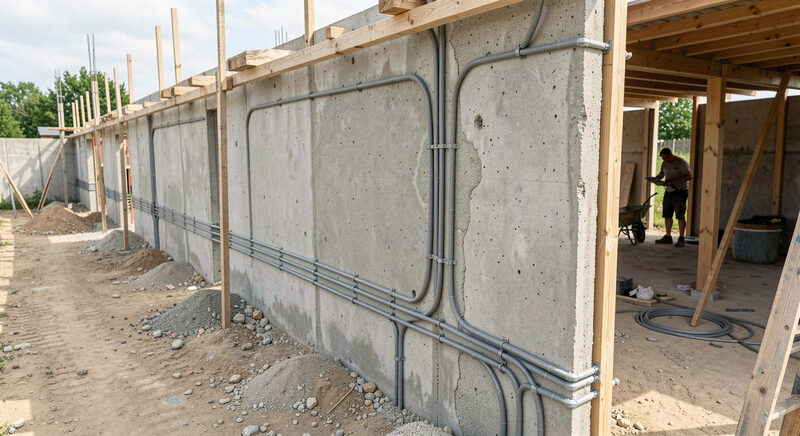
The most visible component sits in the external wall. Thin pipes run in loops through the wall section and carry a fluid that comes from the ground store or the roof. The wall releases that warmth into the room, so no radiator needs to stand in the space. This active layer is called a thermal barrier because it holds a zone between the cold outside air and the warm interior that slows the flow of heat. Because the surface is large, low temperatures are enough, and that suits a heat source that cannot deliver hot water. How the build-up looks in detail, which pipe diameters are used and what the wall can do is covered in the article on the thermal barrier in an external wall. The point here is simple: the wall is not a radiator, it is a large, slow surface.
The ground store as a seasonal buffer
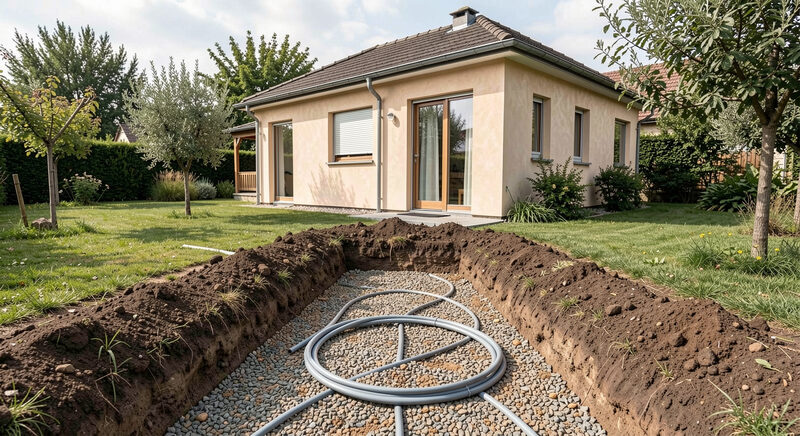
Below the foundation or in the garden lies a store of soil, gravel or concrete, crossed by pipes. In summer it absorbs the surplus heat that the roof collects. Because soil conducts heat poorly and has a large mass, part of that heat survives into winter. Then the flow reverses and the store returns the heat to the wall and the ventilation. This seasonal storage is the heart of the passive idea. It only works if the store is insulated, so the heat does not leak sideways into the ground. How large a store must be, how it is charged and what losses occur is covered in the article on earth tubes and ground heat storage.
Ventilation as the fourth route
Fresh air is essential, otherwise a tight house becomes stuffy and damp. Passive ventilation carries outside air through pipes laid in the ground and tempers it there. In winter the air arrives pre-warmed, in summer pre-cooled. The best known principle is the pipe-in-pipe system, where an inner pipe carries supply air and an outer pipe carries extract air, so the two streams exchange heat without mixing. The warmth of the extract air is not thrown away but kept in the house. How this works, what role the ground plays and when the effort pays off is explained in the article on airtightness and ventilation.
What passive systems cannot do
Passive systems are not magic. They need a site with enough sun, a plot with room for the store and careful planning. In very cold winters, or with a poorly insulated envelope, the stored heat is not always enough, and a small backup heater or a stove is needed. Nor does passive cooling in hot regions replace shading that keeps the sun out of the house in the first place. Knowing the limits keeps a plan realistic.
Climate, plot and cost
Whether a passive system pays off depends on the climate. In temperate latitudes with cold winters and warm summers, the combination of store and ventilation gives the most. In very humid or very cold regions the priorities shift, and the envelope matters more than the store. The plot matters too: with room in the ground a seasonal store is possible, in a tight site the design has to rely on wall and ventilation. The cost falls mainly at the start, in the components. In operation it is low, because no boiler and no air conditioner run. Over many years that offsets the higher investment, especially as energy prices rise.
Maintenance and operation
A passive system needs less maintenance than a conventional plant, but it is not maintenance free. Ventilation needs regular filter changes, so the air stays clean and the fans do not work against a resistance. Pipes in the ground must stay sealed, and the controls must match how the building is used. If the flow temperature is set wrongly, the wall responds slowly and comfort drops. Checking the system once a year keeps the effort low.
Who should plan this way
Passive climatisation works best in new build, because the store and the pipes can be considered from the start. In an existing house a retrofit is demanding but not impossible. Anyone renovating an older building usually begins with the envelope and the ventilation before thinking about a store. An entry point into that order is the section on retrofit and insulation. In the end it is not the single technology that counts but the interplay of envelope, store and ventilation, matched to the climate, the plot and the budget. Get the envelope right first, plan the ventilation second, and most of passive climatisation is already achieved.
Passive Systems
The Thermal Barrier in an Exterior Wall
What a thermal barrier does inside an exterior wall, how it cuts heat loss and why it can work without a heat pump.
A large, slow surface.
Passive Systems
Earth Tubes and Ground Heat Storage
How earth tubes temper incoming air and how a ground store holds summer heat for winter, with the design rules that keep both working.
Summer heat for the winter.
Passive Systems
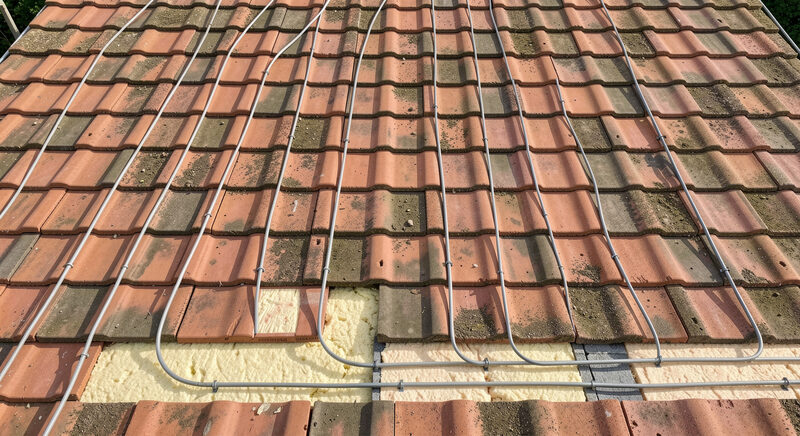
Solar Roofs as Collectors
How a roof can act as a large solar collector, how the heat is carried to a ground store and how that differs from solar panels for power.
A roof that gathers heat.